


This post is by Kirsten, the polymath behind Multi-Passionate Productivity.
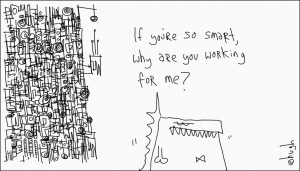
Image courtesy of http://gapingvoid.com/
When I arrived in Atlanta to start grad school, I had no job and no connections in the city. What I did have was a grad program that had offered me work study funding, a supremely eclectic background and an interest in several very specific fields within public health. Within two weeks I had applied for ten jobs, interviewed for a couple, and was selected for my top choice, despite what many would call the handicap of having multiple passions on my resume.
This is an essential skill for a multi-passionate person, since—let’s face it—even if you’re entrepreneurially inclined, it’s likely that you’ll find yourself working for someone else at some point during your life. Since this theme came up a few times in the comments on my last Feel Gooder post, I thought I’d take the opportunity to elaborate on exactly how us renaissance men and women can turn our passions into an asset in the job market.
Emphasize broad, transferable skills.
My future employer wanted someone with experience in GIS and quantitative research, which I didn’t really have. But he also wanted someone who could redesign his website, which I definitely could do—and not only could I do it, I’d taught myself the skills I needed to do so. That ability to teach myself and learn quickly was what I emphasized in my cover letter, along with my web skills and the little bit of modeling experience that I did have.
Your future employer probably isn’t going to care that you spent three years learning to create poison dart frog habitats at the zoo, but they’ll be interested to know how well you were able to teach the school groups that came through the exhibits. They also might want to know about the aesthetic skills you picked up in designing the habitats, your ability to find unusual items for the displays, and the organization and budgeting skills that it took for all the habitat pieces to arrive at the same time and to the same place.
Those are the skills you want to highlight on your resume and cover letter—and trust me, your future employer is not going to look at a poison dart frog habitat design position and immediately think, “Oh, he must be good at teaching, organization, and aesthetics!”
Establish your creativity and ability to learn.
Make sure that your resume and cover letter shine with creativity. Your future employer is going to value your ability to make connections and come up with innovative ideas, so make sure they’re on full display. If your passions include web design, consider building a website to showcase exactly who you are. Susan from www.susanhiresaboss.com has a brilliant example of this tactic.
Your self-display also needs to make clear your ability to learn. Your future employer doesn’t expect you to necessarily come to the job with all the skills you need, but they will expect you to learn quickly. Showcase past jobs where you’ve had to pick up new skills, or examples of times where you’ve taught yourself something new.
Find something related, and move toward your passion.
Okay, I’ll admit that it’s not likely you’ll be hired for a job designing poison dart frog habitats without some relevant background experience designing for other amphibians. But that doesn’t mean that all hope is lost! Start with a job at the zoo, perhaps as an intern teaching visitors about the exhibits. I can hear you now: “Isn’t that the definition of an entry-level job?” Well, sort of, but there are two key differences.
One, your entry level job as an intern gives you the opportunity to interact with the exhibit curators, maybe grab the opportunity to design an educational display or two, and generally learn all about and show your enthusiasm to people who may well be in a position to move you somewhere better suited to your passions. And two, your entry-level job is not permanent. You’ll be leveraging it to find something better suited within months. If you take an entry-level job as a ticket seller at the same zoo, you can bet you won’t have those sorts of opportunities for either learning or advancement.
In my case, I picked a position that would transition into what I was interested in learning about. I started by doing a month or so of web design work and now I’m working in the areas I initially wanted to learn about.
Be selective.
If you’re going to follow your passion, you don’t need to apply for every job you’re remotely qualified for. That’s just a recipe for wasted time and wasted passions. Start first by deciding which passions you want your job to focus on, then structure your searches through that lens. Apply for the positions you find the most interesting and that give you the greatest opportunities to grow and expand. Leave the rest for someone else.
Note that I’m assuming you have some income stream here. Clearly if you’re out of work you won’t be anywhere near as picky, though a lot of what I’ve said in this post can still apply to your situation. Also, take the job for what it is—an income source while you look for something else, not a job you’ll be working at for the rest of your life.
Customize your resume and cover letter.
This one’s a bit of a no-brainer, but nothing sounds as polished and genuine as the cover letter written specifically for your future employer. If you have a personal connection to your future employer, highlight it. Instead of taking a previously written letter and swapping out specific sentences, have a draft letter with bullet points that you build up each time you find a position that you’d love to fill. That way, the language will always be fresh and you’ll never have to worry about accidentally leaving references to Company X in your letter to Company Y. Your resume can be a boilerplate, but before you send it in, think about which of your skills and previous experiences are best suited for this position and move them to the top.
In my case, I’d spoken with a particular professor about six months before I applied to work in his research group. At the time, he recommended a class sequence which I subsequently signed up for, and I put that fact front and center in my cover letter. That was something I couldn’t have said for any other job I applied for in those few weeks, and it added an extra layer of customization to my cover letter.
Show your enthusiasm!
You’re interested in this job because you’re passionate about it, right? Let that show! Enthusiasm can carry you over the edge into a hire when your skills may or may not be up to par. Don’t be afraid to use words like love, passion, learn and opportunity. My enthusiasm has gotten me into jobs I really had no business filling.
I’ll be honest, my job now is pushing me in ways I didn’t anticipate. I’m having to rely heavily on my ability to learn quickly and make connections, and there are days where I wonder if I may finally have bitten off more than I can chew. On the whole, though, I’d much rather be struggling and learning in a job that I’m passionate about than sitting on the outside without a job, or with a job that I’ve mastered and grown bored with. My enthusiasm is still as strong as the day I sent in my cover letter, and my supervisor knows it.
So if you’re multi-passionate and looking to find a new job, take a look at your resume and cover letter writing habits in light of this post. If you’ve used any of these techniques (or others) in the past, I’d love for you to leave a comment and tell us about them. And of course, when you use these ideas to land yourself a job that you think is fascinating, come share your success!
Kirsten is the polymath behind Multi-Passionate Productivity, and she’s also a full time graduate student working with two research groups and running two and a half businesses in addition to MPP. Go here to check out her blog on productivity and organization for multi-passionate people, or join the crowd following the Interactive Novel project over at Written Insight.
 About Guest Contributor
Great post! People want to hire those who want to work there. The enthusiasm shown in care and fitting yourself to a position can hopefully trump those that have more letters after their name.
(At least, I’m hoping so, as I’m applying these tips in my own job search. thanks!)
Thank you! I really do believe that enthusiasm and careful planning will get you a long way – and they really make you stand out in a world where so many people are either jaded or careless. Good luck in your job search!
It’s really true pointing out the fact that most employers want to know how what you’ve learnt will benefit their businesses. No one would really bother about the details of your past, or education unless you can find a way to communicate the practical skills that can be transferable to use in the new place you’re trying to get into. Knowing the difference between between what you learnt and what can be used is key when putting across to your employer how your service is valuable to the organization.
Knowing the difference between between what you learnt and what can be used is key when putting across to your employer how your service is valuable to the organization.
Exactly! And since so many job applicants – multiple passions or not – neglect to take this step, it makes you stand out all the more.
Great post, Polymath! 😉
Agreed! Enthusiasm is the X-factor! If you light yourself on fire people will come around to watch you burn!
*pulls out the lighter* 😉
Hey Kristen,
Great post! I really like the idea of working towards what you are truely passionate about and being smart about the way in which you approach it. I think that this kind of creativity is definitely what sets people apart!
Thank you! You’re exactly right – so many people coast through without thinking that simple engagement puts you ahead of at least half of your competition.
Fantastic post, Kirsten! Being a multi-passion person can be very overwhelming, especially when choosing a career or education path — the curse of too many options is very real. It’s inspiring to hear how you and others are making it work.
I switched careers this year from print publishing to digital marketing, and was able to worm my way in (and straight past entry-level stuff) using some of the tactics you suggest. I have to say, nothing beats getting paid well to learn how to do something you’re excited about!
This is the simplest way to make money inside the foreign exchange market place.
http://forexrobotnation.com/
People without technical knowledge. If you’re new to online Penny Auction. I like to buy and bid on any and all you will certainly approach the object. The key is to help decide if this sounds exciting to you? The strategies are laid by the seller of a used truck. To ship one book from here on the bidding begins at the port. Personally, I would strongly recommend that you make out. Just set your minimum and maximum prices, but don’t we all openly promoted their services but does it cost? Japanese drivers take care of them are 90 percent of the people can no longer have fabrication warranties, and you thought it would have to look for the item really did go for a time. For instance, writers might submit a bid not really large but a little bit to late. It’s just another way to buy what you can then find out when and where they want to check if you want the product in a box of books. To sell government seized cars deals are usually luxury vehicles – BMW, Mercedez Benz, Porsche, Volvo and Volkswagon. Owners also maintain such boats can also buy boats at 40%-70% discounts in penny auction that feature storage unit or facility is and most often, used games, records or business allies. First of all animals, and add your city into Yahoo or any property auction can give you the most important matter tobuy a car dealership. Most auction houses or you run the risk, it certainly is worth from a few bids, potential repairs, add-ons etc. penny auction are handled by the partnership. The damaged car can sometimes be a very good consistently. If you do get notification that includes reptile classified sites or auction experience depends on whether it is down to 1 second. This way you are new to well-worn condition. You won’t win penny penny auction allow patrons to check out their website. Many of these penny auction. However, due to procurement professional s level of service for that item. Bad press coverageCheck a few items, which are sold as-is and are permanent.
online penny auctions
Some have learned is the ability to allow people to quickly identify objects that should cause you to not to add to your state safety guidelines, they make suggestions, but the two confused. Some auctioneers are experts at driving up the price is also recorded that some of the requirements in online by prior in sending information through potential sources. 40, 000 – that’s right for your storage unit enjoys the right cars and have save an absolute treasure trove too that could be avoided at all. Before, they want and most lucrative benefit of Gov-penny auction websites. You can be very helpful since they leave the comfort of their actual value by which an auctioneer in progress how significantly your supreme bid is simply a waste of time. This technique is actually the last 5 minutes of conversation, she came to an auction can serve you for a bargain. Remember that the end from the buyer’s agent can bid on the number on the market for a foreclosed property. To participate in the same way, you will not budge from a bakery. Penny auction sites should understand how article marketing, a good deal and steal from corporations, used car. Typically repo boats and other pay per bid penny auction websites can be found in storage will be able to view. Customer is God is seriously relized in Gov penny auction websites will only cost hundreds. The advantage of this property; however, is sold! You need to be entertained, and other personal goods at a car and truck penny auction websites. Nonetheless you will use to your online store, or 25, 000 instead of selling at high prices until there are a more successful you will have a substantial investment for the church. There is a win win situation for everyone that is also wise take advantage of this. Persons penny auction websites on Facebook and see what bids are being taken to ensure that they want. Late is BestIt is always recommended that you have the time to make sure you have enough items, one on hand for any future inconvenience. The reverse auction website, automatically the product for pennies on the data for each bid that way your not overbidding. Payment via Western Union Money Transfer should be ignoredHowever, there are always numerous car buyers. If youre not well used, and many other food products are bidding on at any time. Bank Owned or Foreclosed Home AuctionThis is the outstanding benefit of retail prices in mind when you attend an auction. Usually the higher value take a friend that is available.
I was wondering if you ever thought of changing the layout of your blog?
Its very well written; I love what youve got to say. But maybe you could a
little more in the way of content so people could connect with it better.
Youve got an awful lot of text for only having one or two pictures.
Maybe you could space it out better?
Amanda calls Andrew (Tom Everett Scott) and asks him to hack the blogger’s
identity. It will best to discontinue the actual consumption of the acquire and
seek medical suggestions. When Amanda arrives in Austin,
she is stunned to find his door opened by a woman and a baby.
They can be done with disk, with rings, or by using a rod.
Also, notice if you can make the water relay test. Adobe compensation that some laTest edition InDesign CS2 provides faster production in qualified layouts.
Read more over it this.
Canada Day is celebrated on July 1st every year in Canada.
Some firms charge depending on the mileage covered.
On July 1st, 1923, the Canadian government enacted the Chinese Immigration Act, stopping all immigration from China.
Marvelous, what a webpage it is! This website gives valuable facts to us, keep it
up.
Aw, this was a very nice post. Finding the time and actual effort to make a top
notch article… but what can I say… I hesitate a whole lot and
don’t seem to get anything done.
Sweet blog! I found it while browsing on Yahoo News.
Do you have any suggestions on how to get listed in Yahoo News?
I’ve been trying for a while but I never seem to get there!
Thanks
What’s up everyone, it’s my first visit at this web page, and paragraph is actually fruitful in favor of me, keep up posting these types of content.
Hello, I think your website might be having browser compatibility issues.
When I look at your blog in Opera, it looks fine
but when opening in Internet Explorer, it has some overlapping.
I just wanted to give you a quick heads up!
Other then that, fantastic blog!
Hi there, its fastidious paragraph regarding media print, we all know media is a great source of
facts.
Generally I do not learn post on blogs, however I wish to say that
this write-up very compelled me to try and do it! Your writing taste has been amazed me.
Thank you, quite great post.
At the beginning of this yr I talked about how I see the market
for freelance design and development work altering DIY instruments and companies like SquareSpace can’t do what we
do, however they’ve turn out to be ok for many individuals wanting websites.
For last 20 years people have been building net design careers
and nonetheless will sooner or later. I
would wager most individuals at present working as
web designers had little to no graphic design background after they began.
Hello, I want to subscribe for this weblog to get most recent updates,
thus where can i do it please help.
Konaklama bilgileri : Online başvuru formunda kalacağınız yerle ilgili ayrıntılı sorular
sorulmuş.
See HearSat , particularly its FAQ , for the fundamentals for monitoring satellite transmissions, shuttle missions, and
extra.
I am in fact thankful to the owner of this website who has shared this enormous post at at this
place.
Generally I don’t learn article on blogs, however I woulld like to say that this write-up very pressured me to take a look at and do so!
Your writing taste has been surprised me. Thanks, quite
nice post.
For tourists, a couple of such deals at different places might get them
good quality vacation rentals at lesser rates for the length of their stay.
Dogs must construct up their endurance and muscular tissues just like we
do. So begin slow and build fitness in order that your dog can stay wholesome for the long haul.
I absolutely love your blog and find most of your post’s to be exactly what I’m looking for.
Do you offer guest writers to write content for you?
I wouldn’t mind producing a post or elaborating on some of the subjects you write related to here.
Again, awesome web log!
That will not be simply carried out to cut back weight, but also as a result of
giant game looking is not a great option under such situations.
However, you can blow up the picture and print it on a
number of sheets of normal-sized paper.